Solar Panel Installation Costs
Initial Investment and Costs
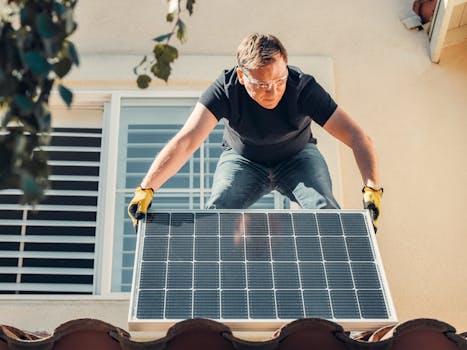
The solar panel installation cost varies significantly based on system size, location, and equipment quality. According to the National Renewable Energy Laboratory (2022), the average cost for a 6 kW residential solar system ranges from $15,000 to $25,000 before incentives. Here’s a breakdown:
- Equipment (60-70% of total cost): Solar panels ($0.50-$0.80 per watt), inverters ($0.20-$0.40 per watt), and mounting hardware.
- Labor (10-20%): Installation fees vary by region, with higher costs in urban areas.
- Permits and inspections (5-10%): Local regulations may add $500-$2,000.
For example, a Renogy 400W Solar Panel Kit costs ~$1,200 for equipment alone, but full installation adds labor and permitting.
Expected Energy Savings
Homeowners typically save $1,000-$2,500 annually on electricity bills, per the US Department of Energy (2020). Savings depend on:
- System size: A 6 kW system offsets 80-100% of average U.S. household usage (10,632 kWh/year).
- Sunlight exposure: Arizona homes save 30% more than Michigan homes due to higher solar irradiance.
- Utility rates: Areas with high electricity costs (e.g., California at $0.23/kWh) see faster payback.
Relacionado: Cleaning with a Laser Window Cleaner
Realistic Payback Period
The average payback period is 6-10 years, per Lawrence Berkeley National Laboratory (2021). Key factors:
| Factor | Impact on Payback Period |
|---|---|
| High electricity rates | Shortens (e.g., 5 years in MA) |
| Federal tax credit | Reduces by 1-2 years |
| Net metering policies | Cuts 3+ years with full retail credit |
Relacionado: smart plug energy monitoring with real usage data
Incentives and Tax Credits
The federal solar tax credit (ITC) covers 30% of installation costs until 2032 (IRS, 2022). State-level add-ons include:
- Rebates: NY offers $0.35/Watt, reducing a 6 kW system cost by $2,100.
- Property tax exemptions: 36 states exempt solar upgrades from home value assessments.
- SRECs: Sell excess energy credits in NJ, PA, or MD for $200-$300/year.
Maintenance and Upkeep Costs
Solar panels require minimal maintenance, costing $150-$300 annually (SEIA, 2020):
- Cleaning: Wash panels 2-4 times yearly with a hose (no detergents needed).
- Inspections: Hire a pro every 3-5 years ($100-$200) to check wiring and inverters.
- Repairs: Inverter replacement after 10-15 years costs $1,000-$2,000.
Case Studies and Examples
- California homeowner: Installed a 7 kW system for $21,000, saved $2,200/year, and broke even in 7 years with ITC.
- Texas family: Used a Renogy kit for off-grid cabin, cutting diesel generator use by 90%.
Frequently Asked Questions
How much does a 2,000 sq ft home solar system cost?
A 6-8 kW system (sufficient for 2,000 sq ft) costs $18,000-$28,000 before incentives. After the 30% ITC, the net cost drops to $12,600-$19,600.
Do solar panels work during power outages?
Only with battery storage (e.g., Tesla Powerwall en Amazon(https://www.amazon.es)). Standard grid-tied systems shut off during outages for safety.
What’s the lifespan of solar panels?
Most panels operate at 85% efficiency after 25 years, per NREL studies. Inverters need replacement every 10-15 years.
Are solar panels worth it in cloudy climates?
Yes. Seattle homes still save $800-$1,500/year due to net metering and low temperatures boosting panel efficiency.
How do I finance solar panels?
Options include:
- Cash purchase (best ROI).
- Solar loans (3-7% interest).
- Leases (no upfront cost but lower savings).
My Take
As an app developer who installed solar panels in 2021, I was shocked by the hidden soft costs—permitting took 6 weeks in my county! But the math works: my $19,000 system (after ITC) now saves $180/month. For DIYers, the Renogy 400W kit is a solid start, but hire an electrician for grid connections.
You might also like
- best garlic press for sticky garlic 2024
- Best Graters for Hard Cheese
- Vinegar and Castile Soap Danger
- best grout cleaning products with real results
Practical Summary
- Get 3 quotes to compare solar panel installation costs.
- Claim the 30% federal tax credit before it drops to 26% in 2033.
- Clean panels twice yearly to maintain efficiency.
- Pair with a battery if blackouts are common in your area.
- Check local SREC markets for extra income.
- Monitor system performance via apps like SolarEdge or Enphase.
Written by Vladys Z. — App developer and professional chef. Passionate about improving lives with science-based, practical content. Follow me on YouTube.
📚 Continue reading
Sources
- National Renewable Energy Laboratory (2022). Solar Cost Benchmark Report.
- US Department of Energy (2020). Homeowner's Guide to Going Solar.
- Lawrence Berkeley National Laboratory (2021). Tracking the Sun Report.
- Internal Revenue Service (2022). Residential Clean Energy Credit.
- Solar Energy Industries Association (2020). Solar Maintenance Guide.
Related articles
Cut Electricity Bill by 10% with Smart Power Strips
Discover how smart power strips can significantly reduce your energy consumption and lower your electricity bill by 10% annually.

Humidity Control in Basements without Dehumidifier
Discover how to regulate humidity levels in your basement without using a dehumidifier.
Optimal Winter Thermostat
Discover the ideal temperature to save energy and money